
All thread inserts are designed and optimized for plastic over molding process.
Inserts are 100% lead free. Manufactured from stainless steel 316L.
Please also ask for our support concerning gripper design and thread insert automation or handling.
sales@steelsert.com
Stainless Steel 316L is a marine-grade alloy with Molybdenum (2–3%), giving it exceptional resistance to corrosion, pitting, and crevice corrosion, even in harsh environments like coastal regions or industrial atmospheres
TDS can be requested from our sales team.

Standard sizes: 65-3
Other sizes upon request

Standard sizes: 65-4, 67-4
Other sizes upon request

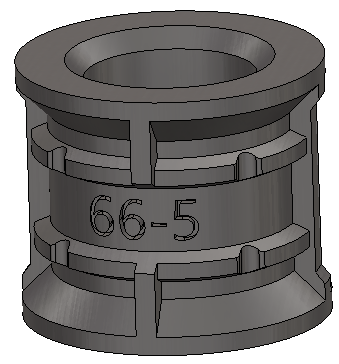
Standard sizes: 66-5
Other sizes upon request
Stainless Steel 316L is a marine-grade alloy with Molybdenum (2–3%), giving it exceptional resistance to corrosion, pitting, and crevice corrosion, even in harsh environments like coastal regions or industrial atmospheres.
Brass, even when Pb-free, is prone to dezincification (zinc leaching), which weakens threads over time—especially in humid, salty, or acidic environments.
In reliability testing, 316L shows up to 5x longer life compared to brass in accelerated corrosion tests.
Pb-free brass is not truly lead-free:
Even “low-lead” brass can legally contain up to 0.1% lead under RoHS, which may be acceptable today but risks stricter regulations in the future.
Stainless Steel 316L is 100% lead-free, inherently RoHS and REACH compliant, zero risk of non-compliance fines, and safe for sensitive electronic environments.
For medical, aerospace, and high-end consumer electronics, 316L meets FDA and ISO biocompatibility standards—brass does not.
Brass is conductive and can contribute to galvanic corrosion when in contact with aluminum or other dissimilar metals—a big issue in EMI/RFI-sensitive electronics.
316L has a passive oxide layer that significantly reduces galvanic coupling and corrosion current, improving long-term electrical stability in grounding points and shielding interfaces
316L inserts have higher tensile and shear strength than brass, reducing thread stripping in high-load or repeated assembly applications.
Brass threads can creep and loosen over time under vibration or thermal cycling. 316L offers dimensional stability at temperatures up to 870°C, making it ideal for electronics exposed to heat (e.g., power modules, automotive electronics).
Life-cycle testing shows stainless inserts can sustain >10,000 fastening cycles without loss of torque performance—brass inserts typically degrade after 2,000–3,000 cycles.
Information included above is based on our current knowledge and
is intended to give details about our products and their possible applications. It has to
be considered as a recommendation and does not refer to guaranteed product properties. Customer
or/and end user is to make own tests for needed validations or approvals.